 listicle
Alternatives to Listing an Outdated House
Table of Contents
- Why Traditional Listing Falls Short for Outdated Homes
- Sell My House Fast Kansas: Cash Buyer Option
- As-Is Home Sale Kansas Laws and Your Rights
- Cost of Home Renovations vs. Selling As-Is
- Converting an Outdated Property into a Rental
- Financing Repairs Without Selling
- Conclusion: Choosing the Right Path for Your Home
Last Updated: August 6, 2026
Why Traditional Listing Falls Short for Outdated Homes
Selling an outdated house through traditional real estate channels often feels like pushing a boulder uphill. The property sits on the market for months, attracting lowball offers from investors who view it as a renovation project rather than a home. Meanwhile, you're paying for staging, repairs, inspections, and realtor commissions, expenses that eat directly into your net proceeds.
This is where many homeowners in Kansas face a critical choice: should you invest thousands in repairs to make the house market-ready, or explore alternatives to listing an outdated house in that bypass the traditional process altogether?
The reality is that outdated properties present unique challenges in today's market. Buyers expect move-in-ready homes or significant discounts. Lenders often hesitate to finance properties with outdated systems, foundation issues, or code violations. The listing process becomes a waiting game, with carrying costs mounting each month the property remains unsold.
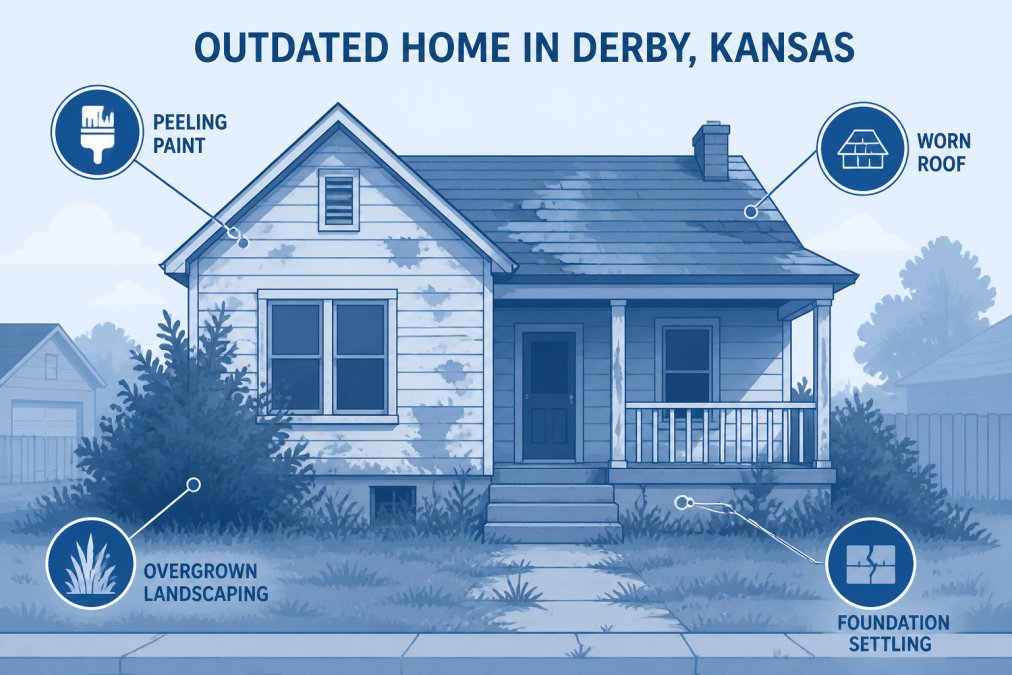
Weathered exterior of an older single-family home with peeling paint, overgrown landscaping, and visible foundation settling in a neighborhood setting, showing natural signs of age and deferred maintenance
The costs compound quickly. A typical real estate commission runs 5-6% of the sale price. Closing costs add another 2-3%. Then there's the inspection period, appraisal contingencies, and potential repair requests from buyers' lenders. For a home that needs significant work, these traditional hurdles become nearly insurmountable.
That's why alternatives to listing an outdated house in Kansas have become increasingly appealing to homeowners facing inherited properties, pre-foreclosure situations, or simply homes that no longer fit their needs. The question isn't whether to sell, it's how to sell in a way that makes financial and emotional sense.
Sell My House Fast Kansas: Cash Buyer Option
The fastest way to sell an outdated house is to work with a cash buyer who purchases properties in any condition. This isn't a new concept, but the execution matters enormously. A legitimate cash buyer removes the traditional obstacles entirely: no repairs required, no inspections, no appraisals, no contingencies.
When you sell to a cash buyer, the transaction moves at your pace. OneRoof Real Estate, which operates in Wichita and across 27 other states, offers all-cash offers within 24 hours and typically closes in 7 days. The company covers all closing costs and commissions, expenses that would normally come from your proceeds. This matters because it means the offer you receive is what you actually walk away with.
The mechanics are straightforward. You contact the buyer, they evaluate the property (usually in person), and they present a cash offer. If you accept, they handle the paperwork and logistics. The seller chooses the closing date. There are no open houses, no staging, no negotiations with inspection contingencies.
For properties in poor condition, foundation issues, code violations, significant deferred maintenance, this approach eliminates the biggest barrier to sale: the need to make repairs before listing. A cash buyer doesn't need a lender's approval, which means they're not subject to the strict property condition requirements that traditional lenders impose.
The trade-off is straightforward: you receive less than you might get at peak market value, but you receive it immediately without carrying costs, repair expenses, or months of uncertainty. For many homeowners, particularly those dealing with inherited property or financial pressure, this exchange makes sense.
As-Is Home Sale Kansas Laws and Your Rights
Kansas law permits as-is sales, but sellers must still comply with disclosure requirements. You cannot knowingly conceal material defects. However, selling to a cash buyer who explicitly purchases properties as-is shifts the liability structure significantly.
When you work with a company like OneRoof Real Estate, the buyer assumes responsibility for the property's condition. They're not relying on lender approval, so they're not subject to lender-mandated repairs. This is the legal distinction that makes the process work: the buyer has already decided to accept the property in its current state.
Disclosure laws in Kansas require sellers to provide a Property Condition Disclosure Form to potential buyers. For as-is sales to cash buyers, this disclosure still applies, but the buyer's acceptance of the as-is offer supersedes negotiation over disclosed issues. You're not hiding problems, you're selling to someone who has already factored them in.
The key protection for sellers is documentation. Keep records of any conversations about the property's condition. When a cash buyer evaluates the property in person and makes an offer anyway, that's evidence that they've accepted the condition. This protects you from later claims that you concealed defects.
One critical point: as-is sales do not eliminate your obligation to disclose known hazards like lead paint in pre-1978 homes. Federal law requires disclosure regardless of sale type. Kansas also requires disclosure of structural defects, mechanical system failures, and other material issues. As-is sales simply mean the buyer accepts these disclosed issues without requiring you to fix them.
Cost of Home Renovations vs. Selling As-Is
The decision between renovating and selling as-is hinges on renovation ROI, and for outdated homes, the math often doesn't favor extensive repairs.
Consider the actual costs. A kitchen renovation for an outdated home might cost $15,000-$30,000 but add only $10,000-$15,000 to the home's resale value. Roof replacement, foundation repairs, or HVAC system upgrades follow the same pattern: the cost exceeds the value added. This is particularly true in iyour market, where outdated homes already face buyer resistance.
The hidden costs compound the problem. Renovation projects typically take 2-4 months. During that time, you're carrying the mortgage, property taxes, insurance, and utilities. If the property is vacant, you're also managing security concerns. These carrying costs can easily reach $2,000-$4,000 per month, depending on the property.
Then there's the execution risk. Renovation projects frequently uncover additional problems. You discover asbestos, outdated electrical systems, or plumbing that needs replacement. A project budgeted at $20,000 becomes $35,000. Meanwhile, the market window closes and you're competing against newer inventory.
For outdated homes, selective repairs make more sense than comprehensive renovation. Focus on curb appeal: landscaping, fresh paint, and minor exterior work. These improvements are inexpensive and influence buyer perception. Avoid major systems work unless absolutely necessary for code compliance.
Staging an outdated property requires a different approach than staging newer homes. The goal isn't to hide the age, that's impossible and backfires. Instead, emphasize the home's character and potential. Highlight original hardwood floors, period features, or lot size. Declutter aggressively. Fresh paint in neutral tones helps. These tactics cost under $2,000 and can make a measurable difference in buyer interest.
However, if the property has serious issues, foundation problems, extensive water damage, code violations, staging and minor repairs won't overcome the fundamental problems. In these cases, selling as-is to a cash buyer becomes the more rational choice financially.
Converting an Outdated Property into a Rental
For homeowners who inherited property or own real estate they no longer need as a residence, converting the house to a rental generates ongoing income rather than a one-time sale.
The rental market in Wichita and surrounding Sedgwick County areas remains steady. Demand for single-family rentals is strong, particularly from families seeking alternatives to apartment living. An outdated home that's unattractive to owner-occupants can still work as a rental if the fundamentals are sound: roof doesn't leak, foundation is stable, mechanical systems function.
The conversion process requires several steps. First, the property must meet local code requirements for rental use. Second, you'll need to decide whether to manage the property yourself or hire a property management company.
Self-management works if you have time, local presence, and comfort handling tenant issues. You collect rent, coordinate maintenance, handle disputes, and manage evictions if necessary. This approach maximizes cash flow but requires active involvement.
Professional property management removes the operational burden. Companies like Real Property Management First Choice handle tenant screening, rent collection, maintenance coordination, and legal compliance. They charge a service fee, typically 8-12% of monthly rent, but handle the day-to-day work.
The financial calculation is straightforward: estimate monthly rental income, subtract property taxes, insurance, maintenance reserves (typically 10% of rent), and management fees if applicable. For a rental property, you're looking at 6-10% annual return on the property value in most markets. This is steady income but requires you to remain a property owner.
The rental route makes sense if you can afford to hold the property long-term and the numbers work locally. For homeowners who need immediate liquidity or can't manage ongoing landlord responsibilities, rental conversion is less attractive than selling.
Financing Repairs Without Selling
If you're committed to keeping the property or believe renovation ROI makes sense, several financing options exist beyond traditional home equity loans.
The USDA Section 504 Home Repair program provides loans up to $40,000 at a fixed 1% interest rate for 20 years, plus grants up to $10,000 for elderly homeowners in eligible rural areas. Most of these areas even qualify for USDA programs depending on specific property location. Income limits apply, this program targets very-low-income homeowners, but the terms are exceptional if you qualify. Applications are accepted year-round with no deadline.
For homeowners who don't qualify for USDA programs, personal loans offer another route. Companies like HFS Financial connect Kansas homeowners with personal loans from $1,000 to $450,000 without requiring home equity or collateral. Fixed rates start around 7.8% with terms up to 30 years. The application process takes minutes and funds are released directly to you. This approach works for renovation budgets up to $50,000 or so, depending on your credit profile and income.
Home equity lines of credit (HELOCs) are available if you have sufficient equity and acceptable credit. These typically offer lower rates than personal loans but require you to have built equity in the property. The advantage is flexibility, you draw funds as needed rather than receiving a lump sum.
The financing decision depends on your long-term plans for the property. If you intend to stay and enjoy the renovations, financing makes sense. If you're planning to sell within 5-7 years, the math becomes more questionable because renovation ROI typically requires holding the property longer to recoup costs and carrying expenses.
Conclusion: Choosing the Right Path for Your Home
Homeowners facing outdated properties in Kansas have genuine alternatives to traditional listing. The choice depends on your financial situation, timeline, and personal circumstances.
If you need to sell quickly and can't afford extensive repairs, cash buyers remove the friction. OneRoof Real Estate specializes in exactly this situation, purchasing properties in any condition, covering all costs, and closing in 7 days. The company has completed nearly 300 closings in the Wichita area and covers all commissions and closing costs, meaning the offer you receive is the cash you walk away with.
If you have time and the property has solid fundamentals, selective renovations and professional staging can improve your traditional listing results. Focus on curb appeal and addressing code violations rather than comprehensive renovation.
If you inherited property and want ongoing income rather than a one-time sale, rental conversion works if the numbers support it and you can manage landlord responsibilities.
The worst choice is doing nothing. Outdated properties deteriorate, carrying costs accumulate, and your options narrow. Start conversations with cash buyers, get professional renovation estimates, or explore rental potential. Armed with real information about each path, you can make a decision that actually serves your situation rather than defaulting to traditional listing because it feels familiar.
Get started with OneRoof Real Estate and receive a fair, all-cash offer within 24 hours, no repairs, no inspections, no fees. The company handles all closing costs and lets you choose your closing date, making the selling process genuinely seamless for distressed situations.
Frequently Asked Questions
Can I sell my house as-is in?
Yes. Kansas law allows as-is sales without disclosure of all defects if the buyer has the opportunity to inspect the property or explicitly waives inspection rights. Cash home buyers specialize in purchasing properties as-is, meaning you avoid repairs, cleaning, and staging. The buyer accepts the property in its current condition. This is particularly common for inherited properties, foreclosures, or homes with foundation issues or code violations. OneRoof Real Estate and other local cash buyers in the area close on as-is properties regularly.
What makes selling to a cash buyer different from listing traditionally?
A traditional listing requires repairs, inspections, appraisals, and typically takes 30-60 days. Cash buyers purchase properties as-is, close in 7 days or less, and cover all closing costs and commissions. You avoid the expense and effort of staging, open houses, and contractor work. The tradeoff is that cash offers are typically below market value—the buyer's profit comes from renovation and resale. For outdated homes in poor condition, the time and cost savings often outweigh the lower sale price.
Is it better to renovate or sell my outdated house as-is?
That depends on your timeline, budget, and the home's condition. Minor cosmetic updates (paint, landscaping, curb appeal) can improve a traditional listing price by 5-10% and cost $3,000-$10,000. Major renovations (roof, foundation, electrical, plumbing) often cost $30,000-$100,000+ with uncertain ROI. If you need to sell quickly, lack capital for repairs, or face extensive structural issues, selling as-is to a cash buyer eliminates renovation risk. If you have time and the home needs only cosmetic work, strategic updates before a traditional listing may yield higher net proceeds.
How do I know a cash buyer is legitimate?
Legitimate cash buyers provide transparent timelines, written offers within 24 hours, and proof of funds before closing. Verify they're locally established—OneRoof Real Estate has completed nearly 300 closings in the Wichita area and is ranked on the Inc. 5000 list. Check for customer testimonials and ask for references. Be wary of buyers who pressure you, demand upfront fees, or refuse to provide written documentation. Local companies with physical offices and verifiable track records are safer than national chains with no local presence.
This article was written using GrandRanker