 how-to
Can You Buy Out Your Spouse's Share of the House in Kansas?
Last Updated: October 27, 2026
Quick Summary
Buying out spouse share of home in Kansas means one spouse keeps the house and pays the other for their equity, while the departing spouse signs over the title and the remaining spouse takes on the full mortgage. A buyout needs an agreed value, agreed equity, and a way to pay, and Kansas courts divide marital property equitably rather than always 50/50.
- A buyout requires an agreed value, agreed equity, and a way to pay; skip one and the deal stalls.
- Start with a licensed appraisal, then subtract the mortgage payoff from your lender's payoff statement.
- On a $300,000 home with a $180,000 payoff, net equity after $21,000 in sale costs is $99,000.
- Refinancing removes a spouse from the mortgage, but lenders approve on income, credit, and debt-to-income ratio.
- Do not sign the deed before the new loan funds, or the departing spouse gives up ownership with nothing in hand.
Table of Contents
- How a Home Buyout Works in a Kansas Divorce
- The Divorce Home Buyout Calculation, Step by Step
- How to Refinance a Mortgage After Divorce to Remove a Spouse
- What a Buyout Agreement for a House in Divorce Should Cover
- Kansas Title Transfer and Closing on a Buyout
- When Spouses Disagree on Value or Terms
- Should You Sell the House During Divorce Instead?
- Get a Cash Offer on the Marital Home
- Frequently Asked Questions
How a Home Buyout Works in a Kansas Divorce
Buying out spouse share of home in Kansas means one spouse keeps the house and pays the other for their equity. The departing spouse signs over the title, and the remaining spouse takes on the full mortgage.
A buyout needs three things: an agreed value, agreed equity, and a way to pay. Skip any one and the deal stalls. Kansas courts divide marital property equitably, fair, not always 50/50 (How Is Property Divided in a Kansas Divorce? 2026 Equitable Distribution Guide).
At OneRoof Real Estate, we buy homes as-is in Wichita and the surrounding counties.
Can One Spouse Keep the Marital Home?
Yes, but only if they can afford it alone and settle the other spouse's share.
Lenders care about your income, not your divorce decree. If you cannot qualify for a loan alone, the buyout fails no matter what the settlement says. Keeping the house to avoid disruption often backfires when the remaining spouse cannot cover taxes, insurance, and upkeep.
Equitable Division and Your Ownership Interest
Kansas divides marital property equitably, not equally, weighing marriage length, contributions, and each spouse's finances (How Is Property Divided in a Kansas Divorce? 2026 Equitable Distribution Guide).
Your ownership interest is what you own; your financial interest is what you walk away with after debts and costs.
They rarely match.
For a reader weighing a buyout against a sale, the broader rules on selling your house during divorce in Kansas cover equity splits and court requirements.
The Divorce Home Buyout Calculation, Step by Step
A divorce home buyout calculation follows a fixed sequence: value the home, subtract the mortgage, split the equity, then adjust for costs and offsets. Get the order wrong and the number is wrong:
- Get a professional appraisal or agreed fair market value
- Subtract the remaining mortgage balance
- Subtract selling costs the home would face if sold
- Split the net equity per your settlement terms
- Adjust for separate property contributions or agreed offsets
- Document the final number in the buyout agreement
Valuing the Home and Subtracting the Mortgage Balance
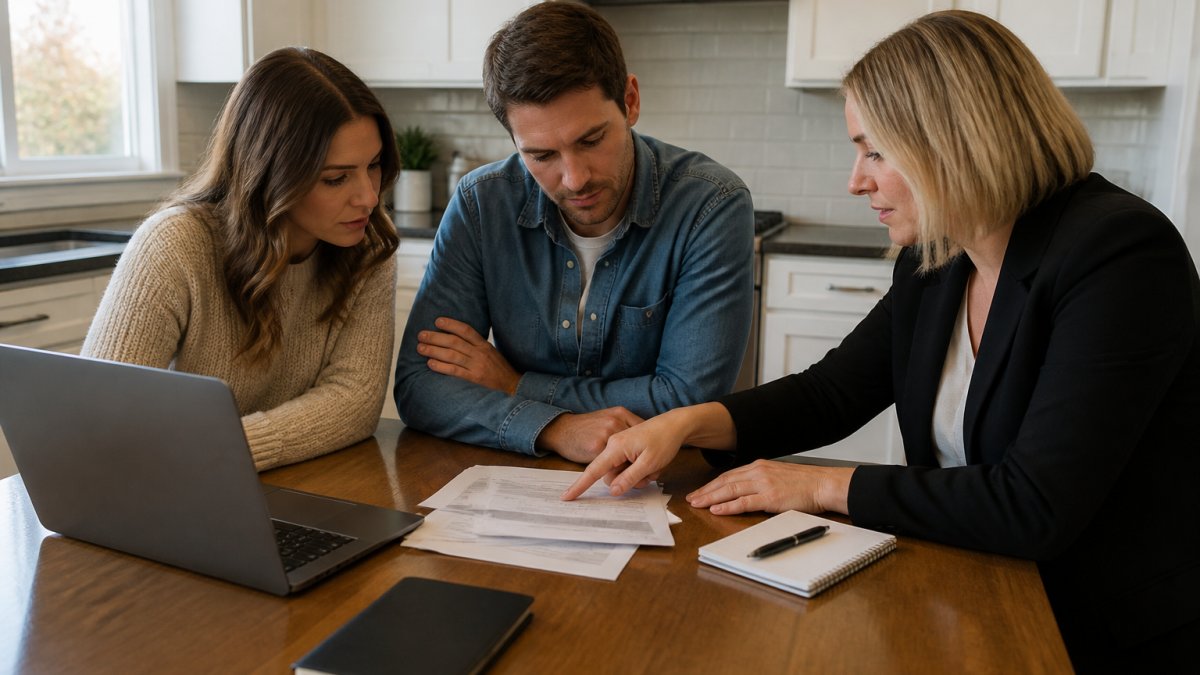
Start with fair market value from a licensed appraiser. A Kansas divorce guide notes that a professional appraisal for a buyout typically runs a few hundred dollars, so treat it as a cost of doing the deal right (Divorce.law's Kansas divorce home guide).
Then subtract the mortgage balance from your lender's payoff statement, not your last bill. Payoff statements include accrued interest and fees and are only good for a set window, often 30 days, so order a fresh one before you sign.
A Worked Example of Equity Division
The gap between appraised value and mortgage payoff is your gross equity.
Subtract costs a sale would carry, like commissions and closing fees; what remains is net equity.
Split that per your settlement, adjusting first for any separate-funds down payment.
For the full math on what a sale actually nets, our guide on calculating net proceeds from a home sale walks through each deduction.
Running the Numbers on a Sample Buyout
Here is how the math looks with illustrative amounts, not quotes for your home.
Now subtract sale costs.
Net equity after those costs is $99,000. If the settlement splits equity 50/50, each spouse's share is $49,500.
Offsets change the number. If the departing spouse already received a $12,000 vehicle from the marital estate, the cash buyout drops to about $37,500.
Turning the Equity Figure Into a Payment
The final step is translating equity into a payment the retaining spouse can make. Three structures are common:
- Lump sum at closing. The refinance or a cash-out loan funds the buyout, and the departing spouse is paid in one check. Cleanest, but it depends on the retaining spouse qualifying for the larger loan.
- Installment payments. The retaining spouse pays the equity share over an agreed term, often with interest. This keeps the loan smaller but leaves the departing spouse exposed if payments stop, so the agreement should include a lien or note.
- Trade against other assets. Retirement accounts, vehicles, or cash offsets replace part of the home equity. This avoids financing but requires each asset to be valued the same way.
Whichever structure you choose, the buyout agreement should state the exact dollar figure, the payment schedule, and what happens if payment is late. A number without a deadline is not a settlement.
Here is the buyout math using the article's illustrative $300,000 home example.
| Item | Amount | Note |
|---|---|---|
| Appraised value | $300,000 | Illustrative amount, not a quote |
| Mortgage payoff | $180,000 | From lender's payoff statement |
| Gross equity | $120,000 | Value minus payoff |
| Sale costs | $21,000 | 6% commission plus $3,000 closing costs |
| Net equity | $99,000 | Gross equity minus sale costs |
| Each spouse's 50/50 share | $49,500 | Split per settlement terms |
| Buyout after $12,000 vehicle offset | About $37,500 | Offsets change the number |
How to Refinance a Mortgage After Divorce to Remove a Spouse
Refinancing removes a spouse from the mortgage: the remaining spouse applies for a new loan alone, pays off the old one, and takes sole title.
Lenders approve on income, credit, and debt-to-income ratio; a divorce decree does not override those standards.
Expect to document:
- The divorce decree and property settlement
- A signed buyout agreement
- Proof of income and assets
If refinancing fails, the options narrow to selling or a court-ordered sale. Our article on selling a house with a mortgage explains how transfers and payoffs work when a loan is still attached.
What a Buyout Agreement for a House in Divorce Should Cover
A buyout agreement for a house in divorce is a written contract setting the price, payment terms, and transfer date. Without one, the decree may leave the mechanics unresolved.
Cover these points:
- Agreed home value and how it was set
- Equity split and any offsets
- Payment amount, timing, and method
Watch out: a handshake buyout with no refinancing deadline leaves the departing spouse liable on a loan they no longer benefit from.
Kansas Title Transfer and Closing on a Buyout
Kansas title transfer on a buyout happens at closing: the departing spouse signs a quitclaim or warranty deed, the county records it, and the refinance pays off the old loan.
Order matters. Do not sign the deed before the new loan funds. If financing collapses after title transfers, the departing spouse has given up ownership with nothing in hand. A title company should run a title search for liens, judgments, or tax claims first; Kansas property taxes follow the property, so unpaid taxes can cloud the title.
Choosing the Deed: Quitclaim vs. Warranty
Kansas recognizes both deed types, and the choice affects risk.
A quitclaim deed transfers whatever interest the departing spouse has, with no warranty of clean title.
A general warranty deed promises the grantor owns the property and will defend the title against claims.
Either way, the deed must be in writing, signed by the departing spouse, and notarized; Kansas does not require a witness, but a notary acknowledgment is standard for recording.
What Happens at the Closing Table
A buyout closing usually involves a title company or escrow agent rather than a real estate agent. The sequence:
- Title search and commitment. The title company confirms the property is clear and issues a commitment listing any liens or exceptions.
- Payoff and funding. The retaining spouse's new lender funds the refinance, which pays off the existing mortgage.
- Deed signing. The departing spouse signs the deed and any settlement documents.
- Disbursement. The title company pays the departing spouse their equity share, pays off the old loan, and records the new deed.
- Recording. The deed is filed with the county register of deeds, and the new lender's mortgage is recorded.
Kansas is a recording state, so the deed is not effective against third parties until it is recorded. Confirm the title company records promptly and sends you a copy.
Kansas Closing Costs and Who Pays Them
A buyout closing carries costs similar to a sale, and the settlement should say who pays each one. Common line items:
- Title search and lender's title insurance. Often several hundred to over a thousand dollars depending on the loan amount.
- Appraisal. A few hundred dollars, usually paid upfront by the retaining spouse.
- Recording fees. Set by the county and typically modest, but they vary.
A common pattern is for the retaining spouse to cover the refinance and title costs, since they are the one keeping the loan and the property. The departing spouse may still owe their share of the payoff and any agreed offsets. Put the allocation in writing before closing.
Coordinating the Decree With the Deed
Kansas courts divide marital property through a divorce decree, and the decree should describe the home transfer specifically. Vague language like "wife shall retain the home" leaves the deed and the lender without clear authority.
The decree should identify the property, state who keeps it, the buyout amount and payment terms, and require the departing spouse to sign a deed.
When Spouses Disagree on Value or Terms
Disagreement is the norm, not the exception. The usual fights are over value, repair credits, and timing.
Break the deadlock with a process, not more arguing:
- Each spouse gets one appraisal; if they differ, split the difference or hire a third
- Put repair disputes in writing with contractor bids
- Set a firm deadline for the buyout, with a sale as the fallback
A judge will decide if you cannot. Court-ordered sales usually net both spouses less than a negotiated deal.
Should You Sell the House During Divorce Instead?
Selling is often the cleaner path.
A sale also ends the mortgage for both spouses at once. No refinancing, no lingering liability, no future disputes over upkeep.
The trade-off is speed and certainty. A traditional listing takes months and depends on buyer financing.
Our comparison of selling a house fast during divorce versus a traditional sale lays out timelines, costs, and steps side by side.
Get a Cash Offer on the Marital Home
A cash offer does not require lender approval.
OneRoof Real Estate buys homes as-is in Wichita and the surrounding counties, including properties with foundation issues and code violations.
We have bought almost 300 houses in the Wichita area.
If you want to see what your marital home is worth to a cash buyer, you can request a cash offer on your home. No repairs, no cleaning, no fees.
Frequently Asked Questions
How is a home buyout calculated in a divorce?
Start with the home's fair market value from a professional appraisal. Subtract the remaining mortgage balance to get total equity, then divide by the ownership split set in your property settlement. If the home appraises at $300,000 with a $180,000 mortgage, equity is $120,000 and a 50/50 split means one spouse owes the other $60,000. That buyout figure is what you pay to buy out your spouse's share, often minus a share of selling costs and any separate property claims.
Can one spouse keep the house and refinance the mortgage after divorce?
Yes, but the lender must approve. A divorce decree does not remove a spouse from the mortgage; only a refinance or an assumption in the lender's name does. To refinance, the spouse keeping the home needs enough income and credit to qualify for a loan covering the existing balance plus any cash taken out for the buyout. If that spouse cannot qualify, the remaining options are selling the home or delaying the buyout until financing works.
What happens if neither spouse can afford to buy out the other?
The usual answer is to sell the home and divide the proceeds according to your property settlement. That converts equity into cash without either spouse needing a new loan. A cash buyer can pay in full, which may be relevant when a divorce timeline is tight or the home needs repairs. Speak with your attorney before listing to confirm how proceeds should be split.
Does a divorce decree remove a spouse from the mortgage?
No. A divorce decree divides property between spouses, but it does not change your contract with the lender. The spouse who keeps the home must refinance or get the lender to approve an assumption to remove the other spouse from the loan. Until that happens, both spouses remain liable for the mortgage, which is why lenders and attorneys treat refinancing as a required step in most buyouts.
Divorce already asks enough of you. Untangling a shared mortgage should not add months of uncertainty. OneRoof Real Estate buys as-is, covers closing costs and commissions, and lets you choose the closing date, so both spouses can split the proceeds and move on. Get started with OneRoof Real Estate and turn the marital home into a clean break.