 comparison
Cash Buyers vs. Auction for Inherited Property
Table of Contents
- Cash Buyers vs. Auction for Inherited Property: Key Differences
- Comparison Table: Cash Buyers vs. Real Estate Auctions
- Probate Property Sale Timeline: Cash vs. Auction
- Pros and Cons of Selling Inherited House to Cash Buyer
- Auction Advantages and Disadvantages for Inherited Property
- Selling Inherited House With Siblings: Navigating Shared Ownership
- Tax Implications, Legal Liability, and Fair Market Value
- How to Choose: Decision Framework for Executors and Heirs
Last Updated: August 9, 2026
Cash Buyers vs. Auction for Inherited Property: Key Differences
When you inherit a property, you face a critical choice: sell it quickly to a cash buyer or list it through a real estate auction. This decision shapes how fast you close and how much money you pocket.
A cash buyer like OneRoof Real Estate makes a direct offer and closes in 7 days or less. An auction creates competitive bidding but introduces complexity, longer timelines, and no guarantee the property sells. At OneRoof Real Estate, we've helped hundreds of heirs navigate inherited property sales across Kansas and 27 other states. The choice depends on your timeline, the property's condition, shared ownership, and whether you need certainty or maximum proceeds.
Comparison Table: Cash Buyers vs. Real Estate Auctions
| Factor | Cash Home Buyers | Real Estate Auctions |
|---|---|---|
| Typical Closing Timeline | 7 days | 20-60 days |
| Upfront Fees | None, seller pays nothing | Listing and auction fees vary |
| Price Guarantee | Firm offer within 24 hours | No guarantee property sells |
| Property Condition | Buys as-is; no repairs needed | Sold as-is; buyer inspects at own risk |
| Best For | Speed, certainty, distressed properties | Competitive markets, investor-grade properties |
| Closing Costs | Covered by buyer | Buyer pays buyer's premium (5% typical) |
| Equity Control | Seller receives full net proceeds | Seller keeps proceeds above reserve price |
Probate Property Sale Timeline: Cash vs. Auction
The probate process adds complexity to inherited property sales. An executor must follow court procedures, file documents, and sometimes get judicial approval before selling.
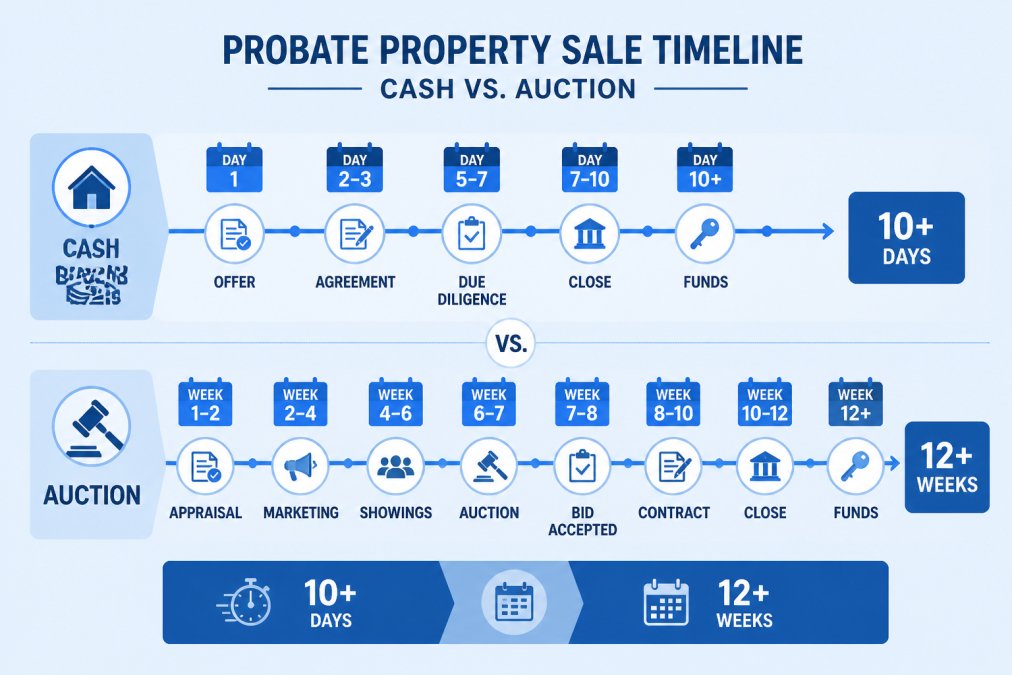
Cash buyer timeline: An executor can close within 7-14 days after receiving an offer. OneRoof Real Estate provides all-cash offers within 24 hours, and the seller chooses the closing date. This matters because probate courts move slowly. A 7-day close gets the property off the books before the next hearing, with no contingencies or financing delays.
Auction timeline: Real estate auctions typically run 3-6 weeks from listing to closing. If the auction reserve price isn't met, the property doesn't sell at all. For executors juggling court deadlines and multiple heirs, this extended timeline creates stress and uncertainty.
Pros and Cons of Selling Inherited House to Cash Buyer
Pros of cash buyers:
Speed means heirs get their inheritance quickly instead of waiting months. Certainty: a cash offer is binding with no inspection contingencies or financing falling through. You know exactly when you'll close and what you'll receive after OneRoof Real Estate covers all closing costs and commissions.
No repairs or cleaning required. Inherited properties often need work, foundation issues, code violations, water damage. Cash buyers purchase as-is. OneRoof Real Estate even provides property clean-out services, saving thousands in disposal costs.
Simplicity for shared ownership. When multiple siblings inherit a property, a cash buyer's straightforward process requires fewer decisions than managing an auction with reserve prices and bid negotiations.
Cons of cash buyers:
Lower offer price is the trade-off. Cash buyers make offers below fair market value because they're taking on risk and closing fast. In a strong market, you might leave money on the table.
Limited negotiation. A cash buyer's offer is usually take-it-or-leave-it. You can't negotiate repairs or closing costs.
Less competition. Only one buyer is making an offer, versus multiple bidders in an auction.
Auction Advantages and Disadvantages for Inherited Property
Advantages of real estate auctions:
Competitive bidding can drive price up when multiple cash buyers bid on the same property. This is especially true for investment-grade properties in growing markets.
No upfront seller fees. Auction platforms charge no listing fees to sellers. Buyers pay a premium (typically 5%), which doesn't reduce your proceeds.
Wider buyer pool. Auctions reach nationwide cash buyers and investors, exposing the property to more potential buyers.
Transparency in bidding. Online platforms show all bids in real-time so you know what the market thinks the property is worth.
Disadvantages of real estate auctions:
No guarantee of sale. If bidding doesn't reach the reserve price, the property doesn't sell. You've spent weeks marketing for nothing.
Longer timeline. From listing to closing typically takes 30-60 days. Executors managing probate court deadlines often can't afford this.
Buyer premium can suppress bids. Buyers account for the 5% premium by bidding lower, potentially reducing your final proceeds.
Complexity with multiple heirs. Auctions require agreement on reserve price, marketing strategy, and timeline, which slows the process when siblings disagree.
Selling Inherited House With Siblings: Navigating Shared Ownership
When multiple heirs inherit a property, the sale becomes a negotiation between family members who may not agree on strategy, timeline, or price.

The probate complication: If the property is in probate, the executor has legal authority to sell after court approval. If held in a revocable trust, trustees can sell without court approval, but all beneficiaries must agree.
Cash buyers simplify sibling dynamics. Because the offer is straightforward and the timeline is short, there's less room for disagreement. OneRoof Real Estate provides a single offer, and the executor can accept it without weeks of debate. The 7-day close means the property is gone before family tension builds.
Auctions require consensus on key decisions. All siblings must agree on the reserve price. If one sibling thinks the house is worth more and the auction doesn't reach the reserve, the property doesn't sell and you're back to negotiating.
Recommendation: For inherited properties with multiple heirs, cash buyers reduce family conflict by eliminating negotiation and uncertainty.
Tax Implications, Legal Liability, and Fair Market Value
Three factors matter: capital gains tax, executor liability, and fair market value.
Capital gains tax on inherited property: When you inherit a property, the IRS steps up the cost basis to fair market value on the date of death. If your parent bought a house for $50,000 and it's worth $200,000 when they die, your cost basis is $200,000. If you sell it immediately for $200,000, you owe no capital gains tax. Selling inherited property quickly locks in the stepped-up basis and minimizes tax liability.
Executor liability: Executors have a fiduciary duty to maximize the estate's value. If you sell an inherited house for significantly less than fair market value, heirs can challenge the sale. Fair market value is the price a willing buyer and willing seller would agree on in an arm's-length transaction.
OneRoof Real Estate addresses this by providing fair, all-cash offers within 24 hours. Our offers reflect actual market conditions. Document everything: get a professional appraisal, compare the cash buyer's offer to that appraisal and comparable sales. This documentation protects you legally.
How to Choose: Decision Framework for Executors and Heirs
Choose a cash buyer if:
You need to close in less than 30 days due to probate court deadlines or estate tax payments. The property is in poor condition, cash buyers purchase as-is. Multiple heirs share ownership and can't agree. You want certainty with no inspection contingencies or financing risk. The property is in a weak market where auction bidding may be limited.
Choose an auction if:
The property is in excellent condition and a strong market where competitive bidding can drive price up. You have time, probate is complete with no court deadline. The property appeals to investors. You want to maximize proceeds and accept the risk of no sale. All heirs agree on strategy.
Decision matrix:
| Your Situation | Best Choice | Why |
|---|---|---|
| Probate court deadline in 3 months | Cash buyer | 7-day close vs. 30-60 day auction |
| Property needs foundation repair | Cash buyer | Buys as-is; no repair costs |
| Multiple heirs who disagree | Cash buyer | Eliminates negotiation |
| Property in excellent condition, strong market | Auction | Competitive bidding drives price up |
| Need certainty on closing date | Cash buyer | Binding offer; seller chooses close date |
| Willing to wait 2 months for best price | Auction | More time for marketing and bidding |
| Out-of-state executor managing remotely | Cash buyer | Minimal coordination required |
Selling inherited property is stressful. You're managing grief, family dynamics, probate court, and financial decisions simultaneously. The right choice depends on your timeline, the property's condition, and whether you prioritize speed or maximum proceeds.
OneRoof Real Estate specializes in inherited property sales for out-of-state heirs and executors managing estates in the Wichita area and across Kansas. We provide fair, all-cash offers within 24 hours, close in 7 days, and cover all closing costs and commissions. Our team handles the complexity so you can focus on settling the estate. Learn more about selling inherited property in Kansas or contact us today for a no-obligation offer on your inherited home.
Frequently Asked Questions
How does the probate process affect selling an inherited house?
The probate process can delay a sale by 3-12 months, depending on state laws and estate complexity. An executor must be appointed, creditors notified, and the court must approve the sale. In Kansas, probate typically takes 4-6 months minimum. Cash buyers and auctions both bypass some delays, but the executor still needs court approval for the sale. Knowing your timeline upfront helps you choose between a quick cash sale or auction.
Do I have to pay capital gains tax on an inherited property sale?
Inherited properties receive a 'step-up in basis,' meaning your cost basis is the property's fair market value on the date of death, not the original purchase price. If you sell shortly after inheriting, you typically owe little to no capital gains tax. However, if the property appreciates after inheritance and you hold it longer before selling, you may owe federal capital gains tax on that appreciation. Consult a tax professional to understand your specific situation and whether cash or auction affects your tax outcome.
What are the risks of selling an inherited home to a cash buyer?
Cash buyer offers are typically 20-30% below fair market value because they assume the risk of repairs and resale. You may receive less money than auctioning or listing traditionally. Additionally, verify the buyer's legitimacy by checking references, proof of funds, and their track record. Some cash buyers use high-pressure tactics or unclear terms. Request a title search and escrow to protect yourself, and never sign documents without legal review from an attorney familiar with estate sales.
Is an auction house sale faster than a cash offer?
Cash offers are typically faster. Cash buyers close in 7-14 days, while auctions take 20-45 days (3-6 day bidding period plus closing). However, cash offers are usually lower in value. Auctions create competitive bidding, which may increase the final price, but there's no guarantee the reserve price will be met. Your choice depends on whether you prioritize speed and certainty (cash buyer) or potential higher proceeds with slightly longer timelines (auction).
What should I look for in a legitimate cash buyer?
Verify proof of funds upfront, check references from recent sales, confirm they're licensed in your state, and ask for their track record in your area. Legitimate cash buyers provide written offers, explain all terms clearly, and don't pressure you into quick decisions. Avoid buyers who demand payment before closing or offer significantly below fair market value without clear justification. Use escrow to protect earnest money, and have an attorney review all documents before signing.
This article was written using GrandRanker