 how-to
How to Identify Foundation Cracks in Homes
Table of Contents
- Why Foundation Cracks Matter: What You Need to Know
- Common Signs of Foundation Problems Beyond Visible Cracks
- Types of Foundation Cracks and What They Indicate
- How to Tell If a Foundation Crack Is Structural
- Step-by-Step Foundation Inspection Checklist
- How to Monitor Foundation Cracks Over Time
- Does Homeowners Insurance Cover Foundation Cracks?
- When to Call a Professional and Next Steps
- Frequently Asked Questions
Last Updated: October 18, 2026
Why Foundation Cracks Matter: What You Need to Know
Foundation cracks are more than cosmetic, they can signal compromised structural integrity. Some stay stable for decades; others expand rapidly and need immediate attention, depending on the cause and width.
At OneRoof Real Estate, we've worked with hundreds of homeowners dealing with foundation issues, some where small cracks became major failures, others where cracks stayed dormant for years.
Learning how to identify foundation cracks early gives you options.
Common Signs of Foundation Problems Beyond Visible Cracks
Foundation problems rarely announce themselves with a single crack. Your home sends warning signals in multiple ways, spotting them helps you catch trouble early.
Look for these indicators:
- Doors and windows that stick or won't close properly
- Floors that slope, dip, or feel uneven
- Gaps appearing between walls and ceilings
Each points to foundation movement, concrete shifting, settling, or under pressure. Cracks in the foundation itself are the most direct evidence.
Water intrusion matters most: moisture entering your basement through cracks means the problem is active.
Types of Foundation Cracks and What They Indicate
Not all cracks are equal, direction, width, and pattern reveal whether a crack is cosmetic or serious structural movement.
Vertical and Diagonal Cracks
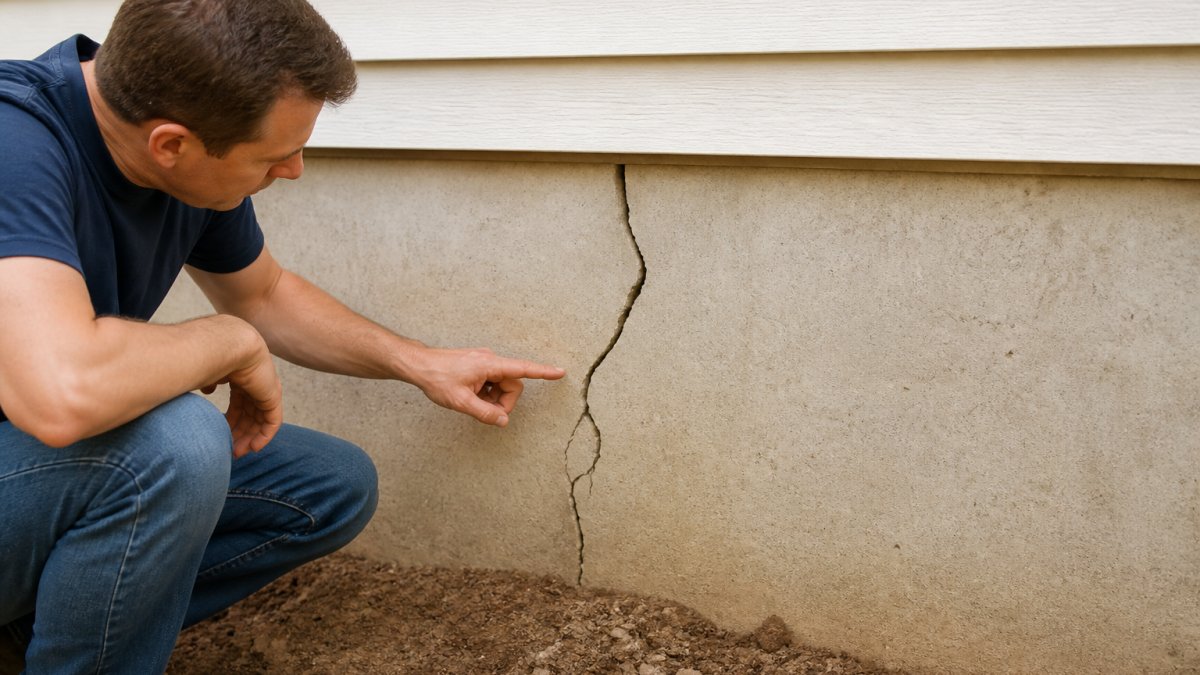
Vertical cracks run straight up and down. Diagonal cracks angle across the concrete at 45 degrees or more.
Vertical cracks typically indicate normal settling. If the crack is under one-quarter inch wide and not growing, it's usually not a concern.
Diagonal cracks can signal uneven settling or soil movement beneath one corner.
Stair-step cracks follow mortar joints in concrete block foundations, zigzagging like stairs, often a sign of horizontal pressure pushing the wall inward, warranting professional evaluation.
Horizontal Cracks and Wall Pressure
Horizontal cracks run side to side across the foundation wall and are the most serious type, indicating external pressure pushing inward.
Soil pressure, water buildup, or clay expansion can force walls inward; as the wall bows, horizontal cracks form.
Horizontal cracks that weep water mean groundwater is pushing against your foundation, this requires drainage solutions and possibly wall reinforcement.
A horizontal crack wider than one-eighth inch should be evaluated by a structural engineer.
Stair-Step and Recurring Patterns
Stair-step cracks follow mortar joints in a diagonal zigzag, signaling horizontal pressure pushing the wall inward, the crack follows the path of least resistance through the mortar.
Recurring cracks reappear in the same location after repair, meaning the underlying cause wasn't fixed, the foundation is still moving or pressure is still building. Investigate the root cause before repairing again.
How to Tell If a Foundation Crack Is Structural
To identify foundation cracks as structural, no single measurement suffices. Width, direction, pattern, location, and change over time all matter, the same crack can be cosmetic in one home and active in another. Separate cracks that merit monitoring from those needing prompt professional assessment.
What Width Can and Cannot Tell You
Width is a screening tool, not a verdict. A common field rule: hairline cracks under about 1/16 inch are often shrinkage or curing cracks, cracks around 1/8 inch deserve monitoring, and cracks approaching 1/4 inch or wider warrant professional evaluation.
Measure the widest point, not the average, and re-measure the same point later. A narrow crack that widens by 1/16 inch over a few months is more concerning than a stable 1/4-inch crack unchanged for years.
Structural Warning Signs
These signs, alone or together, justify a professional assessment:
- Horizontal cracks, especially in a block or poured wall
- Stair-step cracks following mortar joints
- A wall that bows, bulges, or leans inward
Cosmetic and Non-Foundation Causes
Many cracks that worry homeowners aren't foundation movement:
- Concrete shrinkage: hairline vertical or map cracks in slabs and young walls, stable over time.
- Drywall movement: straight cracks at ceiling-wall joints or above door and window corners, often from lumber shrinkage or seasonal humidity swings.
- Plaster cracks: spiderweb or straight cracks from age or impact, not foundation movement.
A crack isolated to drywall or flatwork, dry, and unchanged for a year is usually not a foundation signal. A crack in the foundation wall itself, or one paired with other symptoms, deserves attention.
A Simple Differential Diagnosis
Ask four questions for each crack:
- Where is it? Foundation wall, drywall, or flatwork.
- What direction and pattern? Vertical, diagonal, horizontal, or stair-step.
- Is it changing? Compare dated photos and measurements.
- What else is happening? Doors, floors, water, bowing, or recurring patches.
If the crack is in the foundation wall, is horizontal or stair-step, is changing, or is paired with other symptoms, treat it as potentially structural until a licensed professional says otherwise.
Step-by-Step Foundation Inspection Checklist
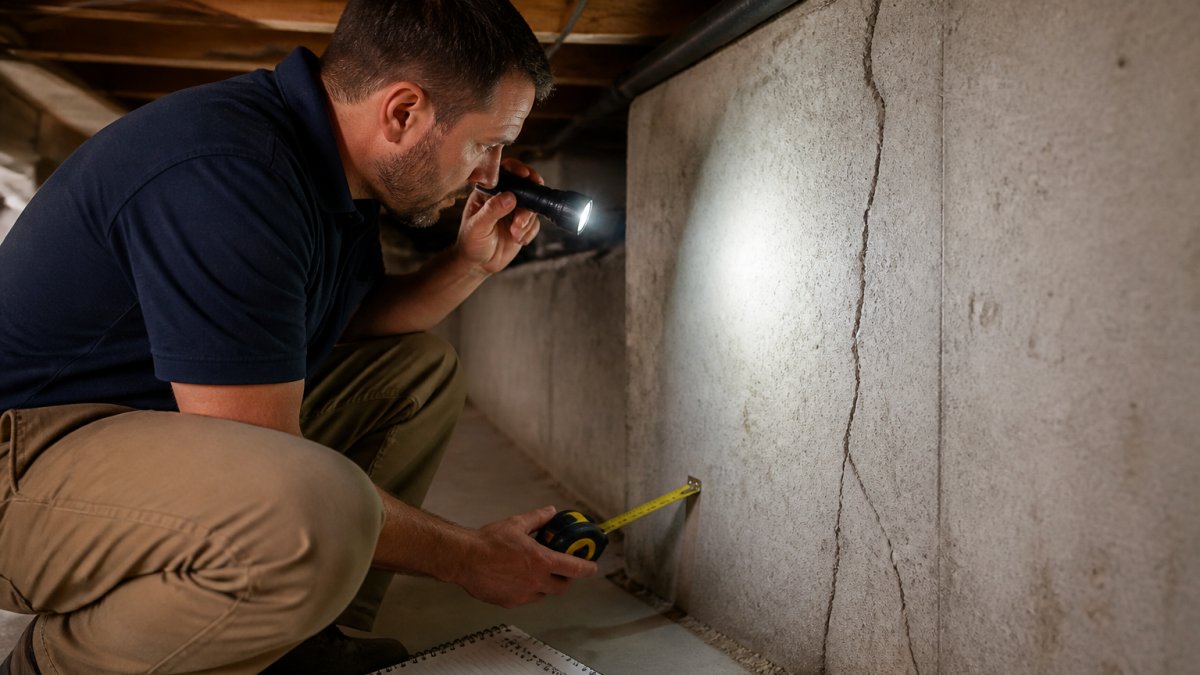
A homeowner inspection is not a diagnosis. Its job is to create a safe, dated record you can compare over time and flag conditions warranting a professional. Work from the outside in, stop when conditions are unsafe, and document consistently so changes are obvious.
What You'll Need Before Starting
- Flashlight or headlamp with fresh batteries
- 25-foot tape measure
- Ruler or crack width gauge
Optional but useful: a small level, a marble for checking floor slope, and a dated folder or cloud album for photos.
Outdoor Inspection Sequence
- Walk the perimeter and photograph each elevation wide, then close. Include the grade line and downspouts in the wide shot.
- Check soil contact. Mulch or soil should sit at least 6 inches below siding or brick veneer and should slope away from the wall. Note any ponding, erosion, or soil pulled away from the foundation.
- Inspect downspouts and extensions. Water should discharge at least 4 to 6 feet from the wall. Note splash blocks that dump water against the foundation.
- Look at the foundation wall where it meets the frame. Note cracks, efflorescence (white chalky powder), rust stains, or previous patches.
- Check window wells, areaways, and garage slabs for cracks or separation from the main wall.
- Photograph any crack with a ruler or coin in frame for scale, and write the date on a tape label next to it.
Indoor Inspection Sequence
- Start in the basement or lowest level. Photograph each wall wide, then close on cracks, corners, and the wall-floor joint.
- Check the rim joist and sill plate for rot, staining, or separation from the foundation.
- Look at the floor-wall joint. A gap that grows along a wall is often more telling than the crack itself.
- Check interior drywall at door and window corners, above headers, and at ceiling-wall joints. Note stair-step drywall cracks and doors that no longer latch.
- Use a marble on the floor to confirm slope direction. Note where it rolls and how fast.
- Smell for musty odors and look for mold, efflorescence, or water staining on the foundation wall.
Measuring and Documenting Cracks
Measure width at the top, middle, and bottom of each crack and record the widest point. Note length, direction, and location (wall, distance from corner, height above floor). Photograph with a scale reference, date a tape label beside the crack, and keep photos in one dated folder for easy comparison.
Testing Concrete Integrity Safely
Do not jab or pry the foundation. Look for flaking, crumbling, or soft mortar joints, and note any surface that brushes away by hand. Efflorescence and rust staining indicate water moving through the concrete; a musty smell confirms moisture. These observations justify a professional look but don't replace one.
Creating a Repeatable Baseline
Take the same photos from the same spots each time. Put painter's tape across each crack with the date written on it; if the crack grows, the tape tears. A simple log with date, crack ID, width, length, and photo number beats a folder of random pictures.
How to Monitor Foundation Cracks Over Time
The most important crack isn't the one you find today, it's the one that's growing.
Create a monitoring schedule:
- Check cracks monthly for the first three months
- Then check quarterly if the crack hasn't changed
- Resume monthly checks if you notice any growth
Compare new readings to old: is the crack wider, longer, or changing direction?
Mark the crack with a contrasting latex paint line and write the date nearby.
Document everything: keep dated photos and measurements in a folder.
Share your findings with a structural engineer if the crack is growing.
Does Homeowners Insurance Cover Foundation Cracks?
Most homeowners insurance policies don't cover foundation cracks from settling or soil movement, these are maintenance issues, not sudden, accidental damage.
Insurance may cover foundation damage caused by specific events:
- Sudden ground movement from earthquakes or sinkholes
- Damage from burst pipes or water leaks inside your home
- Structural damage from fire or explosion
Damage from poor drainage, soil expansion, or normal settling is typically excluded as preventable through proper maintenance.
Review your specific policy. Call your agent and ask explicitly whether foundation cracks are covered and what events trigger coverage, get the answer in writing if possible.
If you have foundation damage and plan to sell, disclose it.
When to Call a Professional and Next Steps
Call a structural engineer or foundation specialist if:
- Any crack is wider than one-quarter inch
- A crack is growing visibly
- You see horizontal cracks or stair-step patterns
A structural engineer will assess whether the crack is cosmetic or structural, identify the cause, and recommend repairs. This evaluation typically costs $300 to $800 but gives you clarity.
If repairs are needed, costs vary widely by cause and severity, some are simple and inexpensive, others complex and costly.
If foundation damage is extensive or repairs are prohibitively expensive, selling as-is to a cash buyer is an option.
Frequently Asked Questions
What do bad foundation cracks look like?
Serious foundation cracks are typically wider than 1/4 inch, horizontal, or stair-stepped in pattern. They may have visible movement, appear alongside bowing or bulging walls, or show signs of water leaking. Horizontal cracks indicate wall pressure and demand immediate attention. Vertical cracks wider than 1/8 inch, especially if they're widening or spreading, also warrant professional evaluation. Cosmetic cracks are usually thin (hairline to 1/8 inch), vertical, and stable over time.
How can you tell if a foundation crack is structural?
Structural cracks show specific warning signs: horizontal orientation, width exceeding 1/4 inch, active widening or spreading, accompanied by bowing or bulging walls, or leaking water. Cosmetic cracks remain stable, are purely vertical, and don't affect wall integrity.
How do you measure and monitor a foundation crack?
Use a ruler or measuring tape to record the crack's width in inches. Mark the crack's endpoints with a pen or tape to track growth. Document the date, width, and any changes. Keep records in a folder or digital file to show a professional or insurance company.
When should you call a foundation professional about a crack?
Contact a professional immediately if you see horizontal cracks, cracks wider than 1/4 inch, stair-stepped patterns, bowing or bulging walls, water leaking through cracks, or cracks that are actively widening. Also call if you notice doors or windows sticking, uneven floors, or multiple cracks appearing in a short time. A professional can determine whether repair is needed or if the issue is cosmetic.
Foundation cracks don't have to derail your plans. Whether you choose to monitor, repair, or sell, the first step is identifying what you're looking at. Use this guide to assess your foundation, document what you find, and make an informed decision about next steps. If you have extensive foundation damage and want to explore a fast, hassle-free sale, OneRoof Real Estate can provide a no-obligation offer for your property as-is, with no repairs required.