 how-to
Calculate the Cost to Sell a House With Major Repairs
Table of Contents
- Understanding the True Cost to Sell a House With Major Repairs
- Step 1: Identify All Selling Expenses and Closing Costs
- Step 2: Estimate Major Repair Costs Using a Home Repair Cost Estimator
- Step 3: Calculate Net Proceeds From Selling a House
- Step 4: Use a Cost to Sell a House Calculator for Accuracy
- Sell a House As-Is Versus Repairing Before Listing
- Account for Hidden Costs: Holding Costs and Contingencies
- Conclusion
- Frequently Asked Questions
Last Updated: October 14, 2026
Understanding the True Cost to Sell a House With Major Repairs
When your home has significant damage, foundation cracks, a failing roof, broken plumbing, selling feels impossible, and most homeowners assume they must fix everything first. That's not always true.
The real question isn't whether to repair, it's whether the repairs will return what you spend. The cost to sell a house with major repairs depends on three things: repair spending, selling expenses, and whether fixing things raises your sale price enough to justify it.
This guide walks you through your true bottom line: estimating repair costs, understanding every fee, and deciding whether selling as-is beats fixing everything first.
Step 1: Identify All Selling Expenses and Closing Costs
Before estimating repairs, understand what selling itself costs, expenses you pay whether your home is perfect or falling apart.
Real Estate Agent Commissions
If you list with a traditional agent, expect to pay commission, typically split between the buyer's and seller's agents. It varies by region and negotiation, but many sellers pay 5% to 6% of the final sale price.
Here's what that means in real dollars:
- Home sells for $200,000: commission around $10,000-$12,000
- Home sells for $300,000: commission around $15,000-$18,000
- Home sells for $400,000: commission around $20,000-$24,000
Commission is negotiable, and some agents accept lower percentages for higher-priced homes. If your home needs major repairs, the lower sale price reduces commission but also means less money in your pocket.
Closing Costs and Title Fees
Closing costs are fees the seller pays at closing, covering title insurance, attorney fees, transfer taxes, recording fees, and other administrative costs.
Common closing cost items include:
- Title insurance and title search
- Attorney fees (if required in your state)
- Transfer taxes (varies by state and county)
The Consumer Financial Protection Bureau's guide to closing costs explains that these fees vary significantly by location. Some states have high transfer taxes; others have none.
The total is usually 1% to 3% of your sale price. On a $200,000 sale, that's $2,000 to $6,000.
Listing and Marketing Expenses
If you list with an agent, they handle marketing and you pay for it, photography, virtual tours, yard signs, and listing fees. Some agents include these in their commission; others charge separately.
Expect to budget:
- Professional photography: $300-$800
- Yard signs and marketing materials: $100-$300
- Listing service fees: $200-$500 (sometimes included)
If your home needs major repairs, professional photography might highlight the damage rather than hide it. Some sellers skip photos when selling as-is, saving a few hundred dollars.
Step 2: Estimate Major Repair Costs Using a Home Repair Cost Estimator
Now comes the hard part: figuring out what repairs actually cost.
Getting accurate repair estimates requires contacting contractors. Don't guess, a contractor's estimate is the only number that matters.
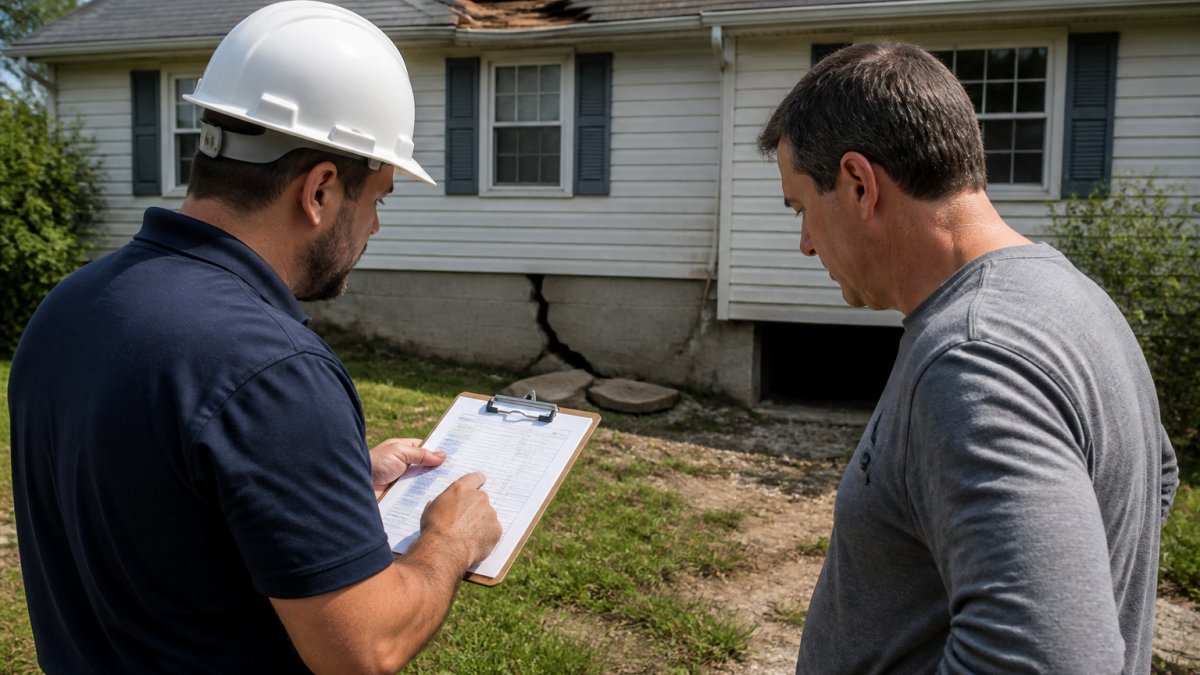
Here's how to get real numbers:
- Walk through and document every problem. Take photos. Note what's broken and how bad it is.
- Call 2-3 contractors per major system. Foundation, roofing, and plumbing specialists give better estimates than generalists.
- Ask for written estimates. Verbal quotes disappear.
- Ask about scope creep. When a contractor opens a wall, they sometimes find other problems. Ask what happens if additional damage is discovered.
Foundation and Structural Repairs
Foundation problems are expensive and scary, buyers often walk away from homes with foundation issues, even repairable ones.
Foundation repairs range widely depending on the problem:
- Cracks in concrete: $500-$3,000 (cosmetic, often not urgent)
- Settling or bowing walls: $5,000-$15,000 (serious, needs professional assessment)
- Water intrusion in basement: $3,000-$10,000 (depends on cause and fix)
The key question: does the buyer care? A cash buyer who buys as-is won't mind foundation issues. On the open market, a failed inspection over foundation issues will tank your deal.
Roof, HVAC, and Plumbing Systems
These three systems account for most major repair costs.
Roof repairs:
- Patching or minor repair: $500-$2,000
- Partial roof replacement (one section): $3,000-$8,000
- Full roof replacement: $8,000-$25,000 (depends on size and materials)
An actively leaking roof is a deal-killer. An aging but non-leaking roof? Buyers might accept it if the price reflects the future cost.
HVAC (heating, cooling, ventilation):
- Repair to existing system: $500-$2,500
- Replace furnace or air conditioner: $3,000-$8,000
- Replace both furnace and AC: $6,000-$15,000
HVAC systems that don't work at all scare buyers. Working but old systems lower your sale price without necessarily requiring immediate replacement.
Plumbing:
- Repair to existing pipes: $500-$3,000
- Replace section of pipes: $2,000-$8,000
- Whole-house replumbing (if pipes are failing): $10,000-$30,000
Old galvanized or polybutylene pipes are red flags buyers know will fail soon. Replacing them is expensive but sometimes necessary to close a deal.
Interior Damage and Code Violations
Interior damage includes water damage, mold, structural issues, electrical problems, and code violations.
- Water damage or mold remediation: $2,000-$10,000 (depends on extent)
- Electrical system updates (to meet code): $3,000-$10,000
- Asbestos removal: $5,000-$20,000 (if present)
Code violations are serious. If your home doesn't meet current building code, missing handrails, unsafe wiring, inadequate ventilation, buyers' lenders might refuse to finance the purchase until violations are fixed.
Step 3: Calculate Net Proceeds From Selling a House
Now you have three numbers: sale price, selling expenses, and repair costs.
The formula is simple:
Let's work through an example:
- Your home would sell for $250,000 on the open market
- Realtor commission (6%): $15,000
- Closing costs (2%): $5,000
But here's the catch: if you sell as-is without repairs, the sale price drops.
Same home, sold as-is:
- Sale price (as-is): $190,000 (20% less because of damage)
- Realtor commission (6%): $11,400
- Closing costs (2%): $3,800
Calculation: $190,000 − $11,400 − $3,800 − $0 − $150,000 = $24,800 net proceeds
In this example, repairing before selling nets you $62,000. Selling as-is nets you $24,800.
But that's only true if you actually get the higher price.
Step 4: Use a Cost to Sell a House Calculator for Accuracy
Doing this math by hand is error-prone. A cost to sell a house calculator helps you test different scenarios.
What-if questions you can answer with a calculator:
- What if I repair only the roof, not the HVAC?
- What if the market drops 10% before I sell?
- What if I sell to a cash buyer instead of listing?
A good calculator lets you adjust:
- Sale price
- Repair costs (by system)
- Holding costs (if the home sits unsold)
Some real estate websites offer free calculators; others require your address and contact info.
The value of a calculator isn't the answer, it's testing scenarios. Run the numbers three ways: best case (repairs done, quick sale), worst case (no repairs, slow sale), and middle case (partial repairs, normal timeline).
Sell a House As-Is Versus Repairing Before Listing
This is the decision that matters most: repair before selling, or sell as-is?
There's no universal answer, it depends on your repair costs, market, timeline, and finances.
When Repairs Make Financial Sense
Repairs make sense when the cost is much less than the price increase they generate.
Example 1: Roof replacement
- Repair cost: $12,000
- Price increase: $25,000
- Net gain: $13,000
Example 2: HVAC replacement
- Repair cost: $8,000
- Price increase: $15,000
- Net gain: $7,000
These repairs pay for themselves and then some. Do them.
But buyer expectations matter. If every comparable home in your neighborhood has a new roof, buyers expect it and yours will be heavily discounted without it.
Location, market conditions, and buyer pool all affect whether a repair generates a price bump.
When Selling As-Is Is the Better Choice
Selling as-is makes sense when:
1. Repairs cost more than the price bump they'd generate
- Repair cost: $20,000
- Price increase: $8,000
- Net loss: $12,000
You'd lose money fixing this. Sell as-is instead.
2. You don't have cash for repairs
Financing repairs is expensive, you'd borrow at high interest and repay from sale proceeds, eating into profit.
3. The home has multiple major problems
One problem? Maybe repair it. Three or four major systems failing? Buyers get spooked. The price discount is steep.
4. You need to sell quickly
Repairs take time. Contractor availability, material delays, inspection punch-lists, all add weeks or months.
5. You're selling to a cash buyer
This is where OneRoof Real Estate comes in.
The National Association of Realtors' research on home repair decisions shows that most sellers overestimate how much repairs will increase their sale price.
Account for Hidden Costs: Holding Costs and Contingencies
You've calculated selling expenses and repair costs. But there are costs hiding in the timeline.
Holding costs are the expenses of owning the home while it's for sale:
- Property taxes: $100-$500+ per month (depends on location and value)
- Insurance: $50-$200 per month
- Utilities: $100-$300 per month (if the home is vacant)
If your home sits on the market for 6 months, holding costs add up fast.
Example:
- Property taxes: $200/month = $1,200
- Insurance: $100/month = $600
- Utilities: $150/month = $900
A quick sale eliminates these. Selling as-is typically closes faster than listing and waiting for a buyer.
Add 10% to 15% to your repair budget as a safety margin. Contractors often find problems when they open walls or start work.
Conclusion
Calculating the cost to sell a house with major repairs means understanding three layers: selling expenses (commissions, closing costs, marketing), repair costs (by system and severity), and hidden costs (holding, contingencies).
If repairs return more than they cost, do them. If they won't, sell as-is. If unsure, test both scenarios with a calculator.
For many sellers facing major repairs, especially those managing inherited property, pre-foreclosure, or a fast timeline, selling as-is to a cash buyer eliminates the repair decision entirely.
Frequently Asked Questions
Can I sell my house if it needs major repairs?
Yes. You can sell a house in any condition, whether it has foundation problems, code violations, or extensive damage. Many sellers choose to sell as-is to avoid the time and expense of repairs. Others prefer to make repairs first to attract more buyers and potentially command a higher sale price. The decision depends on your timeline, available capital, and the cost-benefit analysis of repairs versus a reduced sale price. A cost to sell a house calculator can help you model both scenarios.
What costs should I include when calculating net proceeds from selling a house?
Net proceeds equals your final sale price minus all selling expenses. Include real estate agent commissions (typically 5-6% of sale price), closing costs (1-3% of sale price, covering title insurance, transfer taxes, and attorney fees), pre-listing repairs, staging costs, property inspections, and any buyer concessions you negotiate. Don't forget holding costs if the home sits on the market, property taxes, insurance, utilities, and maintenance add up quickly. Subtract your remaining mortgage payoff as well. A home repair cost estimator helps quantify repair expenses so you can include them in your net-proceeds calculation.
Should I repair my house before selling it or sell it as-is?
Repairs make sense when the cost is significantly less than the price increase they'll generate. For minor cosmetic issues, repairs often pay off. For major structural damage, foundation cracks, roof failure, or extensive water damage, selling as-is may be smarter. Repairs tie up capital, extend your timeline on the market, and carry the risk that a buyer's inspection will uncover additional problems. Calculate the true cost to sell a house with repairs included, then compare it to the likely sale price. If repairs consume most or all of your profit, selling as-is avoids that expense and gets you closed faster.
How do I estimate repair costs accurately before selling?
Get multiple contractor quotes for each major system, foundation, roof, HVAC, plumbing, and electrical. A home inspection report identifies specific defects and helps contractors estimate scope. Use a home repair cost estimator to benchmark costs against regional averages for your home's size and age. Add 10-15% contingency for unexpected issues found during work. For inherited or severely damaged properties, a professional home valuation can help you understand whether repairs will recoup their cost at sale. OneRoof Real Estate buys homes in any condition without requiring repairs, eliminating this uncertainty if speed and simplicity matter more than maximizing sale price.